

Although a SWOT analysis is a common tool in our sector, it can often feel limiting, considering most of our clients are nonprofits operating in the social impact space. Many times, what our clients need is not a “competitive threat assessment,” but rather to understand how they fit into and support a broader ecosystem of actors working towards systems change. That’s why I prefer the SOAR framework.
The SOAR framework is a strengths-based strategic planning tool that stands for Strengths, Opportunities, Aspirations, and Results. (At Minerva, we like to tack on an extra ‘R’ for Realities, but more on that later.) It allows for nuance and mutuality—for example, something may be both a reality and an opportunity, or an opportunity and an aspiration—offering a more holistic view that’s positively oriented towards the future.
Why SOAR and when to use it
A SOAR analysis helps organizations draw connections between present conditions and desired achievements, offering a forward-looking perspective of what’s possible. It’s a great tool for clarifying what matters to an organization and capturing momentum to develop a shared vision across multiple teams, disciplines, and departments. Compared to a SWOT, it’s:
- less prescriptive—it encourages the client to build from its strengths and gives agency to solve problems;
- less binary—just because something isn’t a strength, doesn’t mean it’s automatically a weakness; and
- less competitive—it discourages scarcity mindset, reinforcing that clients already have what they need to be successful, including support when and where there’s lack.
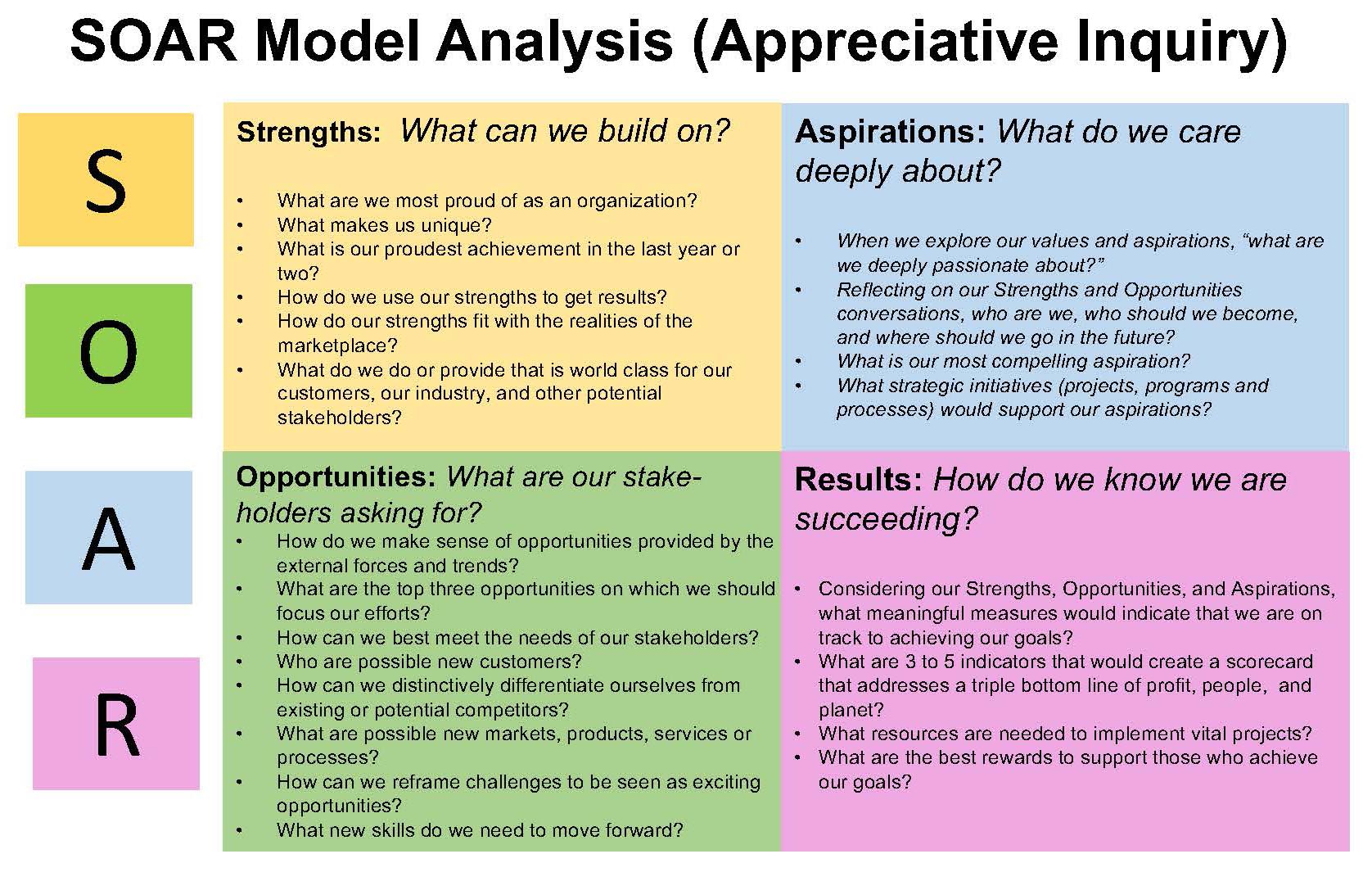
(From: Stavros, J. & Hinrichs, G. (2009). The thin book of SOAR: Building strengths-based strategy. Bend, OR : Thinbook Publishing.)
Using the framework
Let’s use the SOAR framework to analyze some real-world examples. Client A is a brand new, legislatively mandated coalition working to produce a heavily researched statewide strategic plan for improving behavioral health outcomes for youth. Client B has over 30 years’ experience using a proprietary framework support individuals, communities, and organizations broach difficult conversations and navigate conflict in times of change. Client A needs to introduce both itself and the strategic plan to build community and government buy-in, whereas Client B wants to do a better job at communicating outside of its tight-knit, but insular, community.
Strengths: What the client, organization, or program do well, as well as any assets, resources, capabilities, and accomplishments working in their favor.
- Client A has developed an extremely thorough and intentional process for gathering input and building buy-in across sectors, lived experience, and their state.
- Client B’s intergenerational approach to collaboration consistently encourages dialogue between and direct input from youth and elder members on all initiatives.
Opportunities: Any current environmental and external factors that could impact the client, organization, or program, feasibility of goals, and possibilities for growth.
- Client A’s communications materials are oversaturated with jargon and hyper-technical language that could be difficult for the layperson to understand. This may be categorized as a threat in a SWOT analysis, but reframed as an opportunity; it challenges Client A to be proactive in meeting a need / using new and fresh tactics.
- Client B has many youth members who have been involved in the organization since birth and now lead youth programs, which they love to talk to their friends about online and at school. Client B has an opportunity to leverage youth members’ online presence and connectivity to get the word out, cultivating brand ambassadors.
Aspirations: What do stakeholders desire and envision for the future?
- Client A wants to create a shared vision and definitions that are much needed in the behavioral health space.
- Client B would like to see more movement workers and organizations adopt its framework, strengthening collective capacity to build a larger movement over time.
(Bonus!) Realities: Any challenging circumstances, conditions, and tensions (budget, staffing, conflicts, etc.) the client, organization, or program must work within.
- Client A must manage expectations, as their strategic plan will take years to implement amidst ongoing workforce shortages.
- Client B has stakeholders who have been with the organization for three decades and have expressed a natural resistance to change.
Results: The specific, measurable, and tangible outcomes that will indicate the client, organization, or program has achieved its goals and aspirations.
- Client A would like to see an overhaul of the current behavioral health system… But, we’re operating in realities, so a more accessible outcome would be an endorsement from the governor or adoption of the plan by state agencies.
- Client B would like to see their framework adopted by and large as a lifelong practice… Until then, they’ll know they’re on the right track once they have a strong social media following with members actively engaged.
Both are great examples of how the SOAR framework can help clarify and narrow the focus of your efforts to get closer to your end goal.
We like the SOAR framework because it allows us to build off what’s already working well (strengths), considering internal/external variables (opportunities, realities) to map future possibilities (aspirations) and outcomes (results). If you want to dive deeper into the SOAR framework or try it yourself, get started with these resources:
